Vodka's bonds may influence taste


A certain secret agent’s preference for martinis that are shaken — not stirred — might be all about the bonds. Scientists who have zoomed in on the molecular structure of several brands of vodka propose that differences in water-ethanol interactions may account for drink preferences.

Some of vodka’s water molecules form cagelike structures around molecules of ethanol, a research team reports online May 21 in theJournal of Agricultural and Food Chemistry. Disrupting these cages — via impurities or perhaps even shaking — may affect taste, says study coauthor Dale W. Schaefer of the University of Cincinnati in Ohio.

Schaefer cautions that no data link such structural differences to brand preferences. But with more research, a measure of vodka’s microstructure could serve as an all-purpose quality control measure, he says.

Schaefer and colleagues from Cincinnati and Russia used spectrographic techniques to assess the liquid structure of five brands of vodka: Skyy, Belvedere, Stolichnaya, Grey Goose and Oval. Spectral readings of the vodka differed slightly from brand to brand, the researchers found, indicating structural differences in the water-ethanol solutions. The team attributed those differences to the proportion of ethanol molecules that are trapped in a cage of water. When ethanol and water mix, water becomes more structured and the bonds between oxygen and hydrogen tighten up, Schaefer says. Water’s hydrogen atoms are pulled closer to the oxygen atom, imparting a more rigid structure that allows the molecular cages to form, he says.

Sharks use math to hunt


The great white shark in Jaws knew exactly where it was going — to the closest pair of plump legs around. But where might it head if it didn’t have a tasty human snack in its sights?

A new study suggests that some sharks and other marine predators can follow strict mathematical strategies when foraging for dinner. The work, reported online June 9 inNature, is the latest aiming to show whether animals sometimes move in a pattern called a Lévy walk.

Unlike random motion — in which animals take similar-sized steps in any direction, like a drunk stumbling around — Lévy walks are punctuated by rare, long forays in any direction. Draw a Lévy walk on a graph, and its squiggly pattern echoes a fractal, the mathematical phenomenon whose shape remains similar no matter the viewing scale.

“Living organisms, when allowed to make freely willed decisions, seem to end up obeying some kind of mathematical law,” says Gandhimohan Viswanathan, a theoretical physicist at the Federal University of Alagoas in Maceió, Brazil, who was not involved in the study.

Biologists had long thought that animal foraging was dominated by random walks. But in 1996 a team led by Viswanathan reported that wandering albatrosses, fitted with radio-tracking devices, made the occasional long flight that is the hallmark of a Lévy pattern.

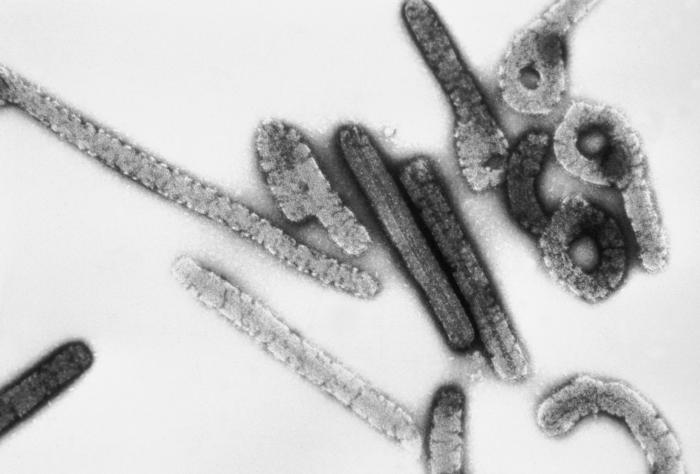
Vaccine for Marburg virus passes monkey test

A devastating tropical virus that has no cure can be ambushed by vaccination a day or two after exposure, tests in monkeys show. The findings suggest that African villagers, health officials and laboratory workers who come into contact with the deadly Marburg virus will someday have recourse to fend it off. The report appears in the July Emerging Infectious Diseases.
Marburg virus is related to Ebola virus. Both cause hemorrhagic fevers — in severe cases leading to shock, delirium and organ failure — and have high mortality rates in humans. This week, the World Health Organization reported five cases of hemorrhagic fever, three of them fatal, among hunters in the Republic of Congo’s remote north.
In recent decades cases of Marburg virus have shown up in Uganda, Zimbabwe, the Democratic Republic of the Congo, Kenya, and Angola, sometimes spreading to other countries via infected travelers.
Earlier research showed that monkeys exposed to Marburg virus and vaccinated within an hour survived (SN: 5/6/06, p. 277). In the new study, six rhesus macaques were exposed to the virus and not vaccinated until 24 hours had passed, a strategy designed to mimic situations in which people are exposed, says study coauthor Heinz Feldmann, a virologist at the Rocky Mountain Laboratories of the National Institute of Allergy and Infectious Diseases in Hamilton, Mont.
Five of the infected animals fended off the disease; one died. Of six other monkeys similarly exposed but not vaccinated until 48 hours had passed, two survived and four died.
Clinical reports of past Marburg virus outbreaks suggest that people can be exposed longer to the virus than monkeys before showing symptoms. Feldmann says that the window of opportunity for vaccination after exposure might therefore be greater. Also the animals in these tests were given a high dose of the virus, possibly higher than the levels people might be exposed to in an outbreak. 
“I think this would have tremendous value in public health workers and families affected by Marburg virus outbreaks,” says Daniel Bausch, an infectious disease physician at the Tulane University School of Public Health and Tropical Medicine in New Orleans. The problem will be to reach people in time, as most people don’t know when they have been exposed during an outbreak. Even so, Bausch says a vaccine could be an “extremely important tool” in those situations.